
📚 Medieval Historical Facts about Italy
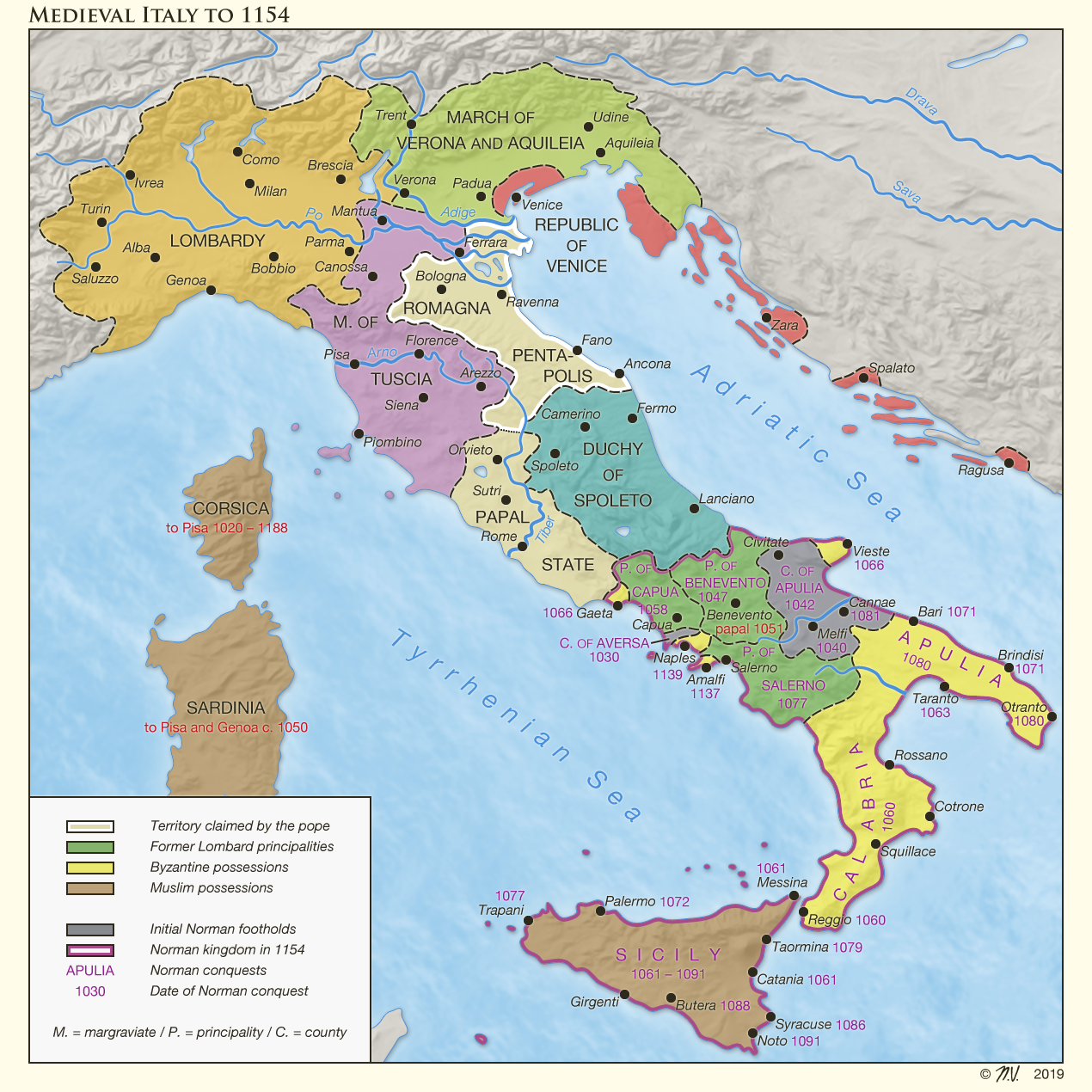
What Was Medieval
Italy?
Italy
during the Middle Ages (5th–15th century) was a collection of
fragmented
city-states,
kingdoms, and the Papal States.
It emerged after the fall of the Western Roman Empire. Society was
dominated by
religion and
regional rule.
Key Themes:
Humanity, Renaissance, Art, Literature, Science
Italy
was central to Europe’s
cultural rebirth.
Key developments in humanism,
art, literature, and science during the Renaissance shaped modern
Western thought.
These themes marked a shift from medieval traditions to modern ideas.

Life and Society
Feudalism in
Italy
Italian
society was structured
through feudalism,
where nobles
controlled lands and peasants
worked them.
Loyalty and service bound people in a strict hierarchy.
Cities began to grow and challenge feudal norms.
Role of the Church
and Monasteries
The
Catholic Church
held immense power in daily life and politics. Monasteries were
centers of learning, preserving ancient texts and educating clergy.
Religious beliefs
shaped law, culture, and education.
Everyday Life:
Cities vs. Countryside
Life
in cities involved trade, guilds,
and a growing middle class, while rural life was hard and tied to
land. Cities like Florence
and Venice
were more advanced and offered opportunities. Most people still lived
in poverty.

Major Cities were:
Rome – The seat of the Papacy and a spiritual center of Christianity throughout the Middle Ages.
Florence (Firenze) – A cultural and economic hub, and the birthplace of the Renaissance, ruled by the powerful Medici family.
Venice (Venezia) – A dominant maritime republic and trading power connecting Europe with the East.
Genoa (Genova) – A powerful seafaring republic and rival of Venice, with influence across the Mediterranean.
Milan (Milano) – A political and military stronghold, known for its wealth and later for being a Renaissance center.
Naples (Napoli) – Capital of the Kingdom of Naples, it was one of the largest cities in Europe during the later medieval period.
Pisa – Known for its maritime strength and universities; rival of Genoa and Venice.
Siena – A rival to Florence, known for its banking, art, and gothic architecture.
Bologna – Home to one of the oldest universities in the world and a key intellectual center.
Padua (Padova) – Renowned for its university and scholars, including Galileo and early humanists.
Verona – An important trade center, famously known today through Shakespeare’s Romeo and Juliet.
Ravenna – Known for its early Christian mosaics and as a former capital of the Western Roman Empire.
Trade and Urban
Growth
Italy’s
location made it a
hub for trade between Europe and Asia.
Cities like Genoa
and Venice
grew wealthy through commerce. Trade boosted cultural exchange and
economic power.
Rise of Merchant
Families (e.g., Medici)
Wealthy
merchant families gained influence by financing art and politics. The
Medici family in Florence became patrons of Renaissance artists.
Their power rivalled kings and the Church.
Major Medieval Merchant Families in Italian Cities
Medici Family –
Florence
The
Medici were powerful bankers and political leaders in Florence. They
funded artists like Michelangelo and Leonardo da Vinci and helped
establish Florence as the center of the Renaissance.
Visconti Family –
Milan
The
Visconti ruled Milan and were involved in trade, finance, and
politics. They laid the groundwork for the Sforza family, who
continued their legacy of patronage.
Sforza Family –
Milan (Post-Visconti)
Although
slightly later, they built on the Visconti power base and were major
patrons of the arts and Renaissance culture in northern Italy.
Barbarigo Family –
Venice
This
Venetian family made wealth through trade and commerce in the
Mediterranean. Several members became doges of Venice, leading its
powerful republic.
Grimaldi Family –
Genoa and Monaco
Originating
in Genoa, the Grimaldi were involved in shipping and finance. They
later moved to Monaco and still rule there today.
Doria Family –
Genoa
One
of Genoa’s most important naval families, they were influential in
both commerce and military affairs. Andrea Doria was a key
Renaissance admiral.
Borgia Family –
Valencia, Spain → Rome
Although
originally from Spain, the Borgia became powerful in Italy,
especially in Rome, through Church positions and political influence.
Este Family –
Ferrara and Modena
Known
for their cultural patronage, the Este ruled Ferrara and supported
artists like Titian and Ariosto. They helped transform Ferrara into a
Renaissance hub.
Bentivoglio Family
– Bologna
The
Bentivoglio were merchant rulers of Bologna, balancing commerce and
politics. They commissioned architecture and arts to enhance their
status.
Malatesta Family –
Rimini
A
powerful family in Romagna, they were known as both mercenaries and
patrons of the arts, building churches and fortresses.
Italian Renaissance
What Sparked the Renaissance?
The
Renaissance was a cultural, artistic, intellectual, and scientific
rebirth that began in Italy during the 14th century and spread across
Europe until the 17th century. The word Renaissance
literally means "rebirth," symbolizing a renewed interest
in the classical knowledge of ancient Greece and Rome after the
medieval period.
Rediscovery
of classical Greek and Roman ideas fuelled the Renaissance.
Trade wealth and the fall of Constantinople brought knowledge back to
Italy. A thirst for learning and creativity emerged.
Humanism: Return to Classical Ideals
Humanism
was a central intellectual movement of the Renaissance that
emphasized the value, dignity, and agency of human beings. It
encouraged the study of classical texts (Greek and Roman literature,
history, and philosophy) and promoted education as a means to
understand the world and improve society.
Humanism
emphasized human potential and achievements, focusing on literature,
history, and moral philosophy. It marked a shift from religious to
individual thought. This shaped education and the arts.
Florence: The
Cradle of Renaissance
Florence
became a center
for art, finance, and learning.
Wealth from banking
and patronage supported artists
like Leonardo
and Michelangelo.
Its cultural legacy shaped Europe.
The Printing Press
and Its Impact
Invented
in the 15th century, the printing press spread knowledge rapidly.
Books became cheaper and more accessible. This accelerated education
and the spread of Renaissance ideas.

Education and the
Rise of Universities
Universities
in Bologna,
Padua, and
others attracted scholars from across Europe. They taught medicine,
law, philosophy, and arts.
Learning shifted from religious control to broader subjects.
Art and Architecture
Evolution of Art in
Medieval Italy
Art
shifted from symbolic
religious images
to realistic
human figures.
Artists
experimented
with light,
perspective, and anatomy.
This evolution defined Renaissance art.

Giotto and the
Transition to Realism
Giotto
introduced more naturalistic figures and expressions in his frescoes.
His work was a major break from medieval flat styles. He is seen as a
pioneer of Renaissance painting.

Brunelleschi engineered the dome of Florence Cathedral using classical techniques. He revived Roman architectural principles. His innovations influenced all of Europe.

The Duomo of
Florence
The
Duomo, or Florence Cathedral, symbolizes the Renaissance. Its massive
dome was an architectural breakthrough. It remains a landmark of
Italian innovation.
Frescoes and
Religious Art
Frescoes
were murals painted on wet plaster, telling religious stories.
Churches became galleries of faith and beauty. Art was used to teach,
inspire, and impress.
Sculpture and Master Artists
 Donatello: Bronze
David
Donatello: Bronze
David

Donatello's "David" was the first free-standing nude statue since antiquity. It captured human emotion and movement. His style blended classical and new techniques.

Michelangelo’s sculptures conveyed intense emotion and detail. His “David” and “Pietà” are masterpieces of anatomy and power. He raised sculpture to new heights. The “David” represents youthful strength and civic pride. The “Pietà” shows Mary holding Jesus, blending beauty and sorrow. Both are Renaissance icons.

Leonardo da Vinci was a Renaissance polymath whose works combined art, science, and deep observation. One of his most iconic pieces is "The Last Supper", painted between 1495 and 1498 on the wall of the Convent of Santa Maria delle Grazie in Milan. It captures the dramatic moment Jesus reveals that one of the apostles will betray him, with each figure showing unique emotional reactions.Mona Lisa: Famous for her mysterious expression and use of sfumato (a technique of soft transitions between colors).
Classical Influence
on Sculpture
Sculptors
studied Roman and Greek art to learn ideal human forms. They adopted
natural poses and realism. This brought classical beauty into
Christian themes.
📖 Literature and Philosophy

Dante Alighieri and
The Divine Comedy
Dante's
epic poem explored heaven, hell, and human morality. Written in
Italian, it set a literary standard. It combined Christian theology
with classical thought.

Petrarch collected classical texts and wrote sonnets that shaped European poetry. He inspired interest in ancient Rome. His work blended emotion and intellect.

Boccaccio’s Decameron told stories of people escaping the plague. It mixed humor, tragedy, and morality. It gave insight into medieval society.

Machiavelli’s book gave advice to rulers on power and leadership. He emphasized pragmatism over morality. It challenged old ideas about kingship.
Science and Innovation
Scientific
Curiosity in Renaissance Italy
Curiosity
led Italians to study the natural world, stars, and the human body.
Science and art worked together. Observation and experiments replaced
superstition.
Leonardo da Vinci:
Scientist and Inventor
Leonardo
sketched machines, studied anatomy, and painted masterpieces. His
notebooks revealed visionary ideas. He was the ultimate Renaissance
genius.
Galileo Galilei and
the Telescope
Galileo
used telescopes to prove Earth revolved around the sun. He challenged
Church views and pioneered physics. His work launched modern science.
Advancements in
Medicine and Anatomy
Doctors
studied human bodies through dissection, improving surgery and
knowledge. Books and illustrations helped share discoveries. Medicine
became more scientific.
Conclusion
Lasting Legacy of
the Renaissance
Italy’s
Renaissance shaped modern art, science, and politics. Ideas of
humanism and innovation still inspire us. Its impact is global and
enduring.
Influence on Modern
Europe
Renaissance
thinking spread across Europe, influencing reform, education, and
government. It helped end the Middle Ages. Modern Europe owes much to
this era.
Cultural Pride and
Identity
Italians
take pride in their Renaissance heritage. Cities preserve art and
buildings from this time. It forms a strong part of Italian identity.